Sunday, August 11, 2013

Calgary 70.3 race report 2013, the run.

This is part 3 of the race report.  Part 1 and Part 2.

Transition 2

Once off my bike, I headed into transition.  Since this race is a point to point race, you don't see T2 before the race.  Last year, I tried to go completely the wrong way out of transition.

This race, I was more prepared with the set up.  The volunteers were also super helpful, making sure I got my bike to the right place.  There was no room for my bike on the rack, so when I asked if I could move one of the other bikes over, one volunteer completely took care of racking my bike for me while the other dumped out my bag so I could get ready.

Change shoes, helmet off, hat on, grab a gel.  I already had 2 gels in my spibelt number belt, along with my inhaler.  There are gels on course, but I don't like relying on them.

I turned to go out of transition, and then turned around to go back.  I'd forgotten to take off my jacket!  I was really glad to have had it on the bike, but there was NO way I'd want it on the run, even if the day was cool, and it was warming up anyways.

Once I got rid of my jacket I was out of transition and ready to run.

The run

It was time to run, the part of the race that I was both afraid of and excited about.  Of course, those two feelings can be almost synonymous, since fear is exciting.

Right after transition, my family was there to cheer me on, so I did a very wide turn in order to catch a couple high fives.


Then it was time to run.  After talking to Angie (my coach) about it, I'd settled on a strategy of running 5 minutes and walking 1.  I wasn't thrilled with the necessity, but it was the reality of doing this race so soon after being cleared to run.  Since I was doing the intervals anyways, I decided to make them work for me.  Rather then dwelling on the fact that I had ahead of me the longest run I'd done in three months, I was only going to think about the interval I was on.  I wasn't running 21 km.  I was just running 5 minutes at a time, until I crossed the finish line.

I quickly settled into my standard post bike run pace, at about 5:30/km.  TOO FAST!  I felt great, but I know very well that I can't actually hold that pace in a race of this distance (yet).  I moderated my pace.  It actually felt easy, but I knew it wouldn't stay that way.

The run of this race is an out and back.  One of the very cool parts about that is the fact that you get to see some of the fast finishers.  I saw a teammate, Sharon (also one of the other team trilife coaches) coming in when I was on one of my early walk breaks, so I used my extra lung energy to cheer her on.  Damn she's fast!  In my age group too.  Hmm, I only have to cut a couple hours off my half ironman time to catch her...

There's about a 4 km loop before going down into the weaselhead.  If you don't have supporters there, it can be painful, because it means you pass really close to the finish line an extra 2 times before crossing it.  If you have supporters though, it's awesome, because it means they see you on the course an extra time.
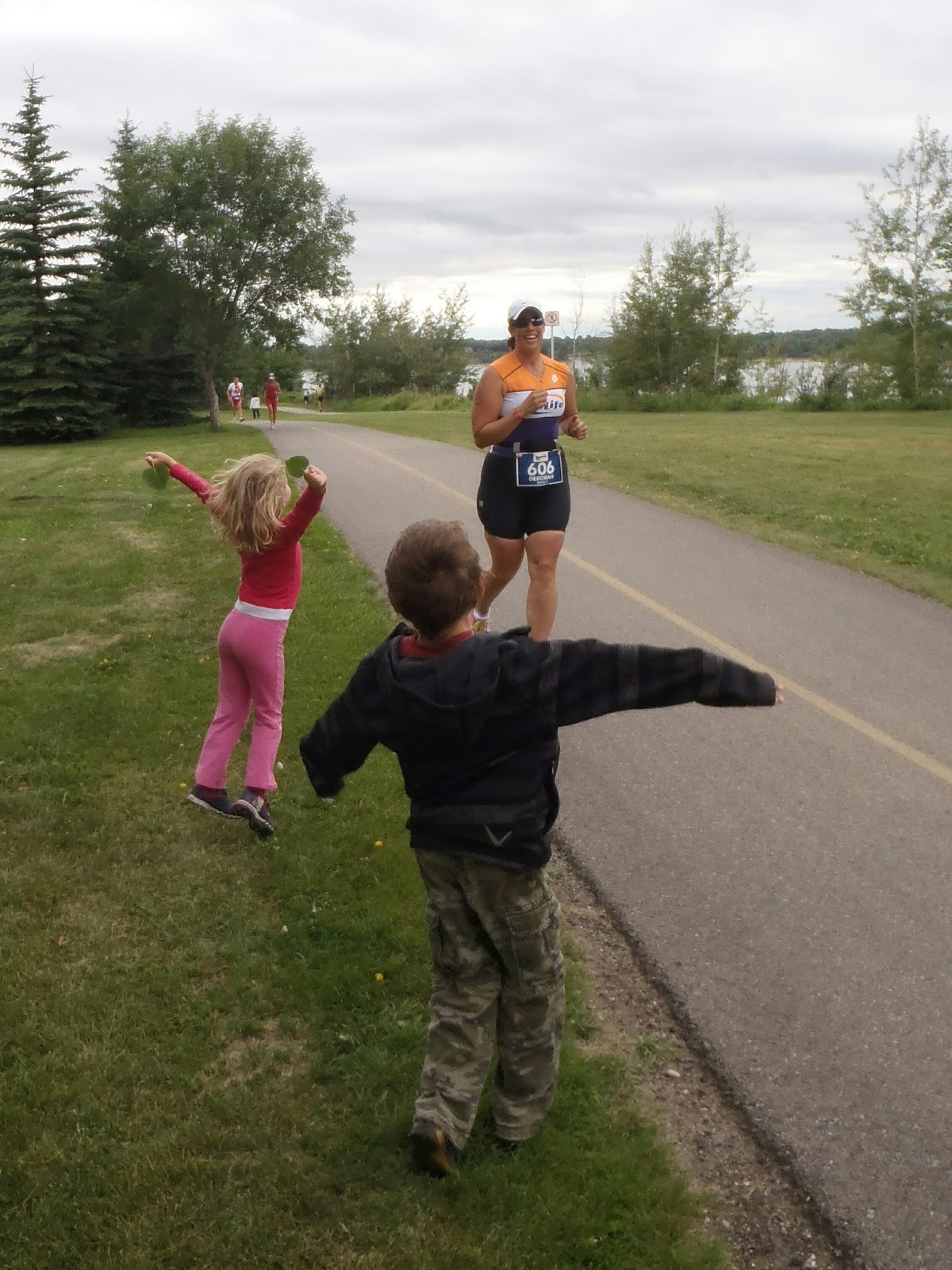
My family was great support on the course.  See the leaves in Sweepea's hands?  Those are her pompoms.
 After a boost from the family, I carried on.  Run 5, walk 1.  It was still easy at this point.  I headed down the big weaselhead hill.  Carefully.  I have done virtually no running downhills since getting back to running, but I really didn't want to walk it.  I focused on not letting the pace get away from me, but at the same time, not using my feet as brakes, if that makes sense.

For the most part, the run was just feeling good.  If I'm 100% honest, I don't feel like I "raced" this race.  I was doing it to complete it, which is exactly what I needed to, but the it didn't start feeling really hard until very late in the race.  My foot felt fine, although, I can't say I really trust my ability to feel pain when I'm in race mode anymore.

Up a really steep hill, and then not long after that was the Team Trilife aid station.  Which was AWESOME!  The cheers that I got were a fabulous extra boost.  Angie asked how I was doing, and I told her I was golden.  I was.  I felt really good.

Not long after that, my tummy started to rumble.  Damn.  I remembered it doing this just a little further along in the race last year.  At that time, a porta potty magically appeared, so I pretty much had forgotten about it.  This time, I was going to have to go a little further to get there.

After stopping off, I carried on.  I was almost at the turn around point, and while I won't say it was still easy, it was only mildly uncomfortable.  The main reason I don't like run/walk intervals is because I find myself looking at my watch to see how far off the walk is.  I don't do it because I need to walk though.  If I was just running I wouldn't do it.  I tried to limit the watch glances.  It does beep/vibrate when it's time.

To the turn around and then back.  My legs were feeling it at this point, and the way back is more up then down.  Carry on.

It was starting to get uncomfortable.  My garmin was the boss.  When the garmin said to run, I ran.  When it beeped after 5 minutes, I walked for a minute.   I made exceptions for the two steep hills on course, and for a few seconds at the aid stations, while drinking from the little cups.

I was walking when I reached the Team Trilife aid station again.  I wanted to run, since the support there is amazing, but I had decided I was sticking to what the garmin said, and there were still about 8 km to go.  Too early to start deviating from the plan.

The really steep hill down after that aid station, I did walk.  I just haven't done enough (any) fast running with high turnover lately, and I've done no downhill running in my training.  I decided not to push it on this one.

When I got to the hill back up, I also walked that one.  The garmin beeped for my walk break while I was on it, and beeped to start running when I got off of it.  This is the point in the race where my legs were really feeling cooked.  My legs would have loved to stop at this point.  I could see the finish line, but instead, I ran past it to finish the last 4K.

Last year, this final stretch was really really tough.  This year, it was hard.  Just hard.  I will admit I wanted to walk.  And I did walk, but only 1 minute out of 6 when my garmin said it was time.  At this point, I shut off the connection between my legs and my brain and carried on.

I saw Trish, a teammate that I've swam with for the last few years.  We'd finished the swim within seconds of each other and played leapfrog on the bike until she left me in the dust as I braked down the hill.  Now, I was reeling her in.  And to distract myself from the fact it was hard, I focused on that for a bit.

I caught Trish when we were just over 1 km away.  One of the spectators encouraged us by telling us "the hard part is over!"

Really?  It felt pretty hard at this point.  Just saying.

Then I picked up the pace.  I was going to finish this race strong.  There was nothing left to hold back for.  Sure it was hard.  It even hurt, but damn it, I was crossing that finish line.  It was the first finish line of a full triathlon this season and the first post injury triathlon.  That finish line meant so much to me.


The medal is awesome.  It's huge.  I did this race last year, and I thought that was a good medal.  The one was a workout to wear.

Official Times:

Swim: 45:31
Bike: 3:36:13 (Including both transitions, about 6 minutes for both.)
Run: 2:39:22

Total time: 7:01:07

Final chapter to come: Post race thoughts

Thursday, August 8, 2013

Calgary 70.3 race report 2013 - the bike


This is part 2 of my race report.  Find part 1 here.  (Sorry for the delay!  I went camping with my family this past weekend and was internet free.)

T1

I headed over into transition and to my bike.  My bike which, very happily, had tires that were nice and full of air.  :)  Thank you to the fabulous folk from Speed Theory.

Off with my swim cap and goggles, on with my sunglasses and helmet.  Socks, shoes.  Arm warmers or jacket?  I had been leaning towards the jacket before the race, on account of likely rain.  I decided that I make more rational decisions when I'm not in race mode, so I should stick with that one.  Jacket it is.

I dried my hands a bit on the towel, but even so my gloves stuck to my hands getting them on.  I know a lot of people don't use gloves in triathlons, but I really prefer the comfort of them for longer races.  Maybe it's partly because I am still riding a road bike, without aero bars.

Then I was heading out.

T1 time: around 3:45 (I forgot to lap my garmin until I was already on the bike.  My garmin says 4:39, but I think it was close to a minute before I hit it.)

Another photo courtesy of Runner Leana
The Bike

Off onto the bike.  The course starts with a loop around the lake before hitting the roads that take us to the highway.  I was feeling pretty good at this point.  Sometimes I have mild nausea after the swim, but it wasn't hitting me at all.

One of my major goals for this race was to stay in the moment.  This meant, at this moment in time, all that mattered was the bike.  Granted, I needed to do it in a way that would allow me to run after, but any worried thoughts about what was coming up in the run were shut down.  I could deal with the run when I got there.  Keeping this mindset helped me a LOT during this race.

As I finished up my loop around the lake, I saw my family and got a little cheer to send me on my way.

The bike course was completely different from last year, on account of a different swim location.  It was a bit short, at 85km, but challenging, with lots of hills in the first half of it.

I geared down when I needed to, and spun up the hills.  I was not going to make the mistake of burning my legs out in the first half of the ride, when I still had a long ways to go on both the bike and run.

My garmin was not fully functional for some reason.  It was giving me my current speed, but wasn't giving me distance, or average speed.  I also wasn't getting an accurate heart rate reading, as anytime I looked, I had a heart rate of about 70 bpm.  Ummm, no.  I wasn't sitting around blogging, which is about what I'd have to do to maintain a heart rate of 70.  I was a bit disappointed about the lack of heart rate info, but it just meant I had to really pay attention to my rate of perceived exertion instead.

There were a couple steeper downhills that I had a tough time with.  I just couldn't keep my hands off the brakes.  Having said that, I did take some of the other hills without braking, something I wouldn't have been able to do even a couple months ago.

Early in the ride, I'd regretted the jacket and was wondering if I'd have to stop to tie it around my waist, or something.  By this point in the ride, I was glad I'd made that decision.  It was cool, and kept threatening to rain.  In fact, my finger tips were occasionally feeling numb, so I was glad for the gloves as well.

I had my garmin set to beep every 10 minutes to remind me to hydrate and fuel.  I didn't always fuel when it beeped.  If I was descending, passing, or cornering at the time, I'd wait.  I liked having it to remind me though, as sometimes I can easily go 45-60 minutes without remembering to fuel, not the best idea in a long race.  This kept me right on track.  I was using stroop waffles (like honey stinger waffles, but not individually packaged, or marketed for sports, so way cheaper), drinking heed and had some gels as well.

Then I was passing Bragg Creek, and I knew the most challenging part of the course was behind me.  In some ways, it is good that my garmin wasn't giving me full data.  I can get obsessed with the average speed number, as I'll always work out the average speed I need to maintain in order to meet goals or cut off times.  That might work on a completely flat course on a wind-free day, but I haven't been on a course like that yet.  In this particular course, nobody could maintain the same average speed for the first half that they'd be able to reach in the second.  The second half of this course is mostly a false flat going down.

I heard sirens and just hoped they were unrelated to the race.

Once onto highway 8, the shoulder we were riding on got a lot narrower.  There was not room for two riders unless one went onto the rumble strips.  It was late enough in the course that there wasn't a tonne of passing, but there definitely was still some happening.

At one point, I was approaching a guy and debating whether to pass.  Sometimes I find, the person in front slows down very temporarily to eat or drink and if I pass, they either start pedalling hard while I'm passing, or pass me again right away.  Not so this time.  I wasn't braking, but I had stopped pedalling and was still gaining on the guy.  I'd have to brake to stay out of his draft zone, and this was an easy section of course.

At this point of the highway, there was actually room to go on the other side of the rumble strips while still staying in the shoulder.  I moved over and called out to let him know I was passing.  I did a quick check to make sure I was ahead of him and could pull back in, when another women came through right between us.  She did say something as she came through, but if I'd moved in a second sooner, or skipped shoulder checking, it could have been bad.

I was probably at about 70 km by now and was feeling really good on the bike.  I remember last year being really, really uncomfortable by this point.  I've changed my saddle since then and that's made a huge difference in long ride comfort.  I've also really been working on my posture and position, which has helped with the numbness I typically get between my shoulders.  And, quite frankly, I've just spent more time on my bike this season.

The one annoying thing about the course was the way the signs were placed along the highway.  Basically, there's a smooth shoulder, then a fairly wide rumble strip, then the highway, where cars were zooming past.  There were signs set up to inform motorists of the race that was going on, except they were set up in the smooth part of the shoulder.  This meant that you had to continually weave back and forth between the rumble strip and the smooth pavement.

I came to one section where traffic was stopped going both directions.  I'd already slowed down, but as I approached, there was a woman who told me to slow waaaay down.  Then I was stopped, with emergency vehicles spread out in front of me.  I'm not sure how long, but I'd guess 3-4 minutes.  I was the first triathlete stopped, but very soon, there was a group waiting.  Finally, an ambulance pulled away, the police let some traffic from the other direction go, then we did.

As I rode past, I saw the one thing I was hoping I wouldn't: a riderless bike on the ground.  (Reports since the race are that 3 people were injured.)

As horrible as it was, I knew I had to shake it off.  I wasn't the victim, and I couldn't help the victim by dwelling on it.  Keep riding.

In the last few kilometers of the bike, I started thinking about transition and mentally rehearsing it.  Before long, I had turned and was on the final stretch to transition.  Keep pedaling.  Stay relaxed.  When I reached the dismount line, I stepped off my bike, confidently, with no tip over fears  I headed into transition, to prepare for something I hadn't done for 3 months: run 21 km.

Up next: the run!

Tuesday, July 30, 2013

Calgary 70.3 Race Report - 2013, The swim


Sunday, I completed my second half ironman.  When I signed up for it last fall, I saw myself blowing away my performance from 2012.  Then, three months ago, I had the experience that almost every endurance athlete has to deal with at some point.

An injury.

In my case, a stress fracture.  In terms of running, it's a game stopper of injuries.  Oddly, at the same time, it's one of the simpler ones to heal.  (Not necessarily easy, but simple.)  Bones can heal fully, provided you are smart enough to give them the rest they need.  There's no debate; you have to stop running on it.  There is some debate as to how long.   In my case, I spent 4 weeks in an aircast, letting my bone heal, while my muscles atrophied.  Then, 4 weeks of walking without the aircast, but still no running unless it was in a pool.  That left me being able to hit the road running 1 month before the race.

My run training was a mix of water running, elliptical, and some actual running, with run/walk intervals.  I am so thankful for my coach, Angie.  If I hadn't had her, I don't know if I would have made it to this start line.  I would have had no idea how to structure my run training to safely get there.  When it came down to it, I hadn't actually run more then 10km on the road for exactly three months, the day I ran my last half marathon.

This is where I was going to have to trust the training.  I had done some very long pool runs.  I'd also had a couple long "runs" where I spent a good two hours alternating between running and the elliptical.

Pre-race

This is the first time my husband and kids came with me to an early morning race start.  I had been a bit stressed about this, but my husband took care of all the kid stuff, leaving me to worry about my last minute race preparations, mainly getting my hydration and nutrition together.  We had planned to leave the house at 5:00 am, and were pulling out of the driveway at 5:05.  Not bad, in comparison to the planning.

Due to the recent flooding in the Calgary area, the swim was in a completely different location, at Mackenzie lake, in South Calgary, rather then Ghost Lake, which is close to Cochrane.  This meant it was about an hour drive in the morning, rather then the 15 minutes it would have been.

There was no parking nearby, so I got my husband to drop me off, while he and the kids went to park.  I headed over to body marking and looked for Leana, as she was volunteering there.  I found her husband, Neil, first.  I joked that I was looking for her, but he would do.  He told me that I could still have Leana if I wanted.  I asked who had the nicer writing, and when it was determined it was Leana, she was called over.
Leana was kind enough to put my number right side up, even though I gave her an upside down age a couple weeks ago.  (Photo courtesy of Neil, stolen from Leana's facebook page.)
Then I headed over to my bike.  I was feeling a bit tight on time, and realized that although we had left the house almost on time, we should have planned to leave earlier.  The drive was almost an hour.  I had arrived at the race with less an hour to go, and taking into account set up, the porta potty line up, getting the wetsuit on, and doing a warm up swim, I had no leeway.

Since my husband was there to give it to, I had brought my own bike pump.  I got my nutrition set up on my bike then went to pump up the tires.  I started to unscrew the presta valve on the rear tire, and the end of it came shooting off as all the air forcefully expelled.  I stood there somewhat dumbstruck and almost ready to cry.

I know how to change a tire, and some of my visualizations of the race even included that possibility.  At the moment though, it just seemed completely overwhelming.

The girl next to me was the voice of reason.  "Best time for that to happen," she said.  "Take it over to bike support.  They'll help you with it."

I wheeled it over to bike support and tried to get a handle on my emotions.  Not a big deal, I told myself.  She was right.  Way better that this happened now then have it happen mid race.  Still, when I got to the bike support tent, I was still teary eyed.

"Are you okay?  Can I help you with something?" one of the guys asked me.  I explained the situation, and he immediately took my bike from me and started changing the tire.  I can't say how thankful I am to Speed Theory for helping me out.

While my tire was changed, I went back and set up my transition.  I like to keep my transition zone pretty simple, but this time, I did have the extra items of a jacket and arm warmers.  The temperature was supposed to be kind of cool, and I hadn't decided which to wear on the bike.

I retrieved my bike and gave incredible thanks for it.  Then I saw the porta potty line. The really long porta potty line.  I took my wetsuit with me and waited in line.  And waited.  While I waited, I heard them announcing that everyone needed to come out of the water.  Okay, no swim warm up.  Finally, I reached the front of the line and did my thing.  Then I headed to a little grassy corner and got my wetsuit on with a couple other people.

While getting my wetsuit on, I heard the singing of "Oh Canada".  I was zipping it up as the pro men wave started.  I had planned to give my dry clothes bag to my husband, but I didn't see him around, and didn't have time to look, so I just dropped it off at the official drop off and headed down to the beach.

By the time I got there, the pro women had gone, and the teams were being sent off.  That meant there was one wave left before mine, the age group men.

I found my kids off to one side watching the start and gave them a hug.  My husband was just getting back from looking for me.  They wished me luck, and I went and took my place on the beach.

I was actually feeling very calm, and ready.  It's amazing how just three years ago, I was afraid of the deep end of the pool and now, the swim was the part of the race I was the least worried about.  It was a bit of a challenge to seed myself, but I looked around and realized I was standing behind some men.  Since the age group men had already gone, they had to be part of the newbie wave, which went after the age group women.  I moved forward some until I was pretty sure I was in front of the newbies.
I'm in the black wetsuit
Then, it was time to go.

The Swim

In the last few races, I've discovered that, for my current swim ability, how I enter the water is more important then how I seed myself on the beach.  I pass anyone who is doing the obvious hanging back and walk brickly to the edge of the water.  The people in the front that sprint for the water stay ahead of me (as they should) and the others entering similarly are either close to my speed or a bit faster.

Then I was in and swimming.  I was bumped and jostled a few times, but I took it in stride,  something I'm very pleased I can now do.  I concentrated on getting my stroke smooth and avoiding any panic kicking, and I started to watch for feet to draft, if they should happen to appear.

I even found them.  I don't rely on drafting, but when I can, I've started trying to.  I've found that since I've stopped hanging back at the beginning, it's easier to find those feet.

The swim went really smoothly.  If anything, I would say it was a very comfortable swim.   I continued to draft for about half the swim.  At that point, I touched the girl's toes, and she stopped really abruptly and pulled up in the water.  I carried on and went around her.

There's a tunnel in this swim course, which was kind of cool.  It was darker, but not pitch black.  By now, the faster swimmers from the newbie group had caught up and were starting to pass.  Out of the tunnel and I just kept going.  Concentrating on a long, smooth stroke.  No panic kicking, which is a habit I have in open water, whether I'm panicked or not.

At one point, I was a bit confused about which way to go, so I probably lost a bit of time before realizing there was now a triangular buoy to head for.  The lake was only just big enough for this swim, so it had more turns then you would normally see.

Then it was into the shore.  I concentrated on feeling the water and pulling as much as I could.  I felt really strong at this point.  I kept swimming until I reached the boat launch and then waited until I was touching the bottom.

Up, onto my feet.  I undid my wetsuit, got it to my waist and headed over the strippers, then it was into transition to get ready for the bike!

Swim time: 45:31  (Garmin measured at 2.09km, quite possibly a bit of crooked swimming in there.)


Next up: The bike and run!  (Maybe together, maybe separate, depends how long it ends up being...)

Saturday, July 27, 2013

The day before the race

Tomorrow is the big race.  The BIG race.  I'll be toe-ing the line at Calgary 70.3.  It's my second half ironman, but it feels like my first.

Because, in many ways it is my first.

It is my first full triathlon of the season.  It is the first post-injury race that I will be running in.  And, it's a HALF IRONMAN.  Quite frankly, I'm afraid.

The physical training is done.  I have a swim this morning, but even that is more mental preparation then physical.  There will be no further improvement to my fitness level at this point.

So, what about the fear?  I have two main techniques I use.  The first is logic.

Logically, I'm ready for this race.  In fact, I have never felt more prepared for a swim and bike portion.  The open water swimming has really been clicking for me and I think I am at the highest level of bike fitness I have reached yet.  I'm a little disappointed that the bike course is different this year, as it gives me no opportunity for direct comparison from last year.

Then there's the run.  Well the main fear is the post injury fear.  The "what if it's not really better" fear.  Logic?  Logically, I truly believe the bone is fully healed.  I have been running on it for a month.  There is no pain from the injury point.  None.  Now, there's no more reason to believe that I will be injured in this race then at any other point in the past of future.

Sometimes, a little voice reminds me that I have not run 21.1 km for three months, but is that a fear?  When I think about it, not really.  I've run the distance many times in the past.  Physical training is important, but I've done that.    My long "runs" in lead up to this have been largely on the elliptical, but I know that they have still prepared me for this race.  It's my mental strength that is going to get me through the run.  It's not going to be easy.  It is going to hurt. But, I have the mental power to push through it.

One thing the injury experience has given me is the ability to say "I ran a half marathon on a stress fracture.  I can do this."  And, I can do this.  And I will.

So, am I still afraid?  A little bit.  Here's my other technique: Noted.

Tomorrow, I will cross the finish line of my second half ironman.

Completely unrelated to the post, here's some strawberries I picked from my garden for breakfast.

Saturday, July 20, 2013

Up the Hill, up the hill...

It was about two years, and my first run with my new running friend, Krissy.  It was a great run, and we connected quickly and the conversation flowed freely.  As we ran, we approached one of the bigger hills that, given it's proximity to my house, has always been a part of many of my runs.

"I always walk this one," I said, as I pulled up to a walk.

Krissy just kept going.  Not fast, but consistent.  Steady.  Running up a hill that I had considered virtually unrunable.  When we got to the top of the hill, she mentioned having done hill repeats in the past.

"That's crazy," I stated.  "Why would I ever do that?"


Last week, I stood at the bottom of that same hill, preparing to do the hill repeats that Angie had given me.  2 minute climb, 3 minutes, 4, 3, 2 min.  (1 minute running, 1 minute walking, out of consideration of the fact I'm coming back from injury.)

And, I found out that same hill, the one, 2 years ago, I considered a huge obstacle, was actually too short.  I ran up that hill 7 times, rather then 5, in order to make up the total climbing time.

Then this week, another session of hill repeats.  It was a very similar workout, but slightly longer with two 2 minute climbs at the beginning and end of the pyramid.  I chose a different hill, a longer one, and got to it.

And loved it.  There's something incredibly satisfying about doing hill repeats.  In terms of the actual workout, it's very easy to break it down into sections.  You don't have to think about the fact you're going to run up that hill 7 times.  You just have to focus on the current 2, 3, or 4 minute interval.  Then back down.  Sadly, because of the foot, right now, I have to walk down, but I can't wait to do it when I can cruise down, get my leg turnover up, and let the hill carry me.

There's a determination when doing the repeats.  When I reach the bottom of the hill, I turn around, hit the lap button on my garmin, and go back up.  No hesitation.  Just do it.

And the satisfaction upon finishing that final climb.  It's amazing.  Total accomplishment.  It's hard, and it's worth it.

Post hill session, the sweat has partly dried, but the red face has't quite gone away.

Sunday, July 14, 2013

Bloggy catch up post!

Now that I am post injury and feeling excited again, I've been wanting to get back to blogging.  The problem is, every time I think about something to blog about, I think "I should really catch up on this first" or "I should write that race report first".

Rather then trying to catch up in a bunch of individual posts, I've decided to do one mass catch up post.  Then I can go back to blogging about whatever I want.

Injury Status

1. It has now 10 weeks since being diagnosed with a stress fracture.

2. The first 4 weeks, I spent in an aircast or on crutches.

3. I did my first triathlon of the season on crutches - just before being released from the aircast.  I did the swim and bike.  My husband did the run.  I used crutches to get to the pool, and between the pool and the bike.


4. I started doing physiotherapy about 4 weeks in.  My primary concern at that point was that my calf muscle had atrophied while in the aircast.  In addition to working on the calf, we've also worked on hip strength, and core.

5. From 4-8 weeks, I was allowed to walk normally, but no running or other impact.  As my daughter informed me, that also ruled out ballet jumps.

6. 2 weeks ago, I was cleared to run.  I ran.  1 minute at a time to start, but building from there.

7. Nobody can tell me why I got the stress fracture, and I've come to accept that.  The most likely answer seems to be a combination of things.  I'm optimistic that a more balanced approach to training, which finally includes consistent core and body-weight strength work will help prevent a re-occurrence.

8. I am no longer an injured athlete.  I am playing catch up now, as my run training is not where I would have liked to see it, but I am now healthy and working towards my goals again.

Running Status

9. During the time period that I wasn't allowed to run, I logged countless hours pool running.

10. My longest pool run was 1 hour, 35 minutes.  Technically, my program said 1.5 hours, but I wanted to prove to myself that not only could I mentally endure it, I could do it even longer then I had to.

11. Pool running is boring.  But doable.  Music helps.  I was very thankful of my waterproof ipod.

12. I was cleared to run 2 weeks ago.  This was 2 months after diagnosing the stress fracture, and 1 month prior to Calgary 70.3, a Half Ironman that will be my first full triathlon this season.

13.  Since being cleared to run, I've been doing run walk intervals, the longest run intervals, so far, are up to 4 minutes.  I did accidentally run for a solid 7 minutes when I zoned out and didn't notice my garmin vibrating.

14. I don't really like run/walk intervals.  I feel like I never really get into my rhythm, but running is running, and I'll take it.  I am getting used to it, but I feel like I'm always looking at my garmin to see when I switch to running or walking.  I'd rather just run.

15. I've also been spending time on my elliptical trainer.  I'm now happy that I never got around to selling it when we bought the treadmill.  It's been a very useful tool in building back my run fitness.

15. To get me ready for Calgary 70.3, Angie has me doing some elliptical/run/elliptical workouts for my long runs.  This week it was a total of 1 hour, 35, with only the middle 25 minutes being run/walk.

16. This is going to be a real test of trusting my training, trusting my body, and trusting my head.  I've been known to train as much as 25km, for my long run, in preparation for a half marathon, simply because it assured me I could go the distance.  This time, I'm going to have to trust that a very different type of training will get me ready.

Swim status

15. Initially, my doctor only gave me permission to swim with a pull buoy, as long as I didn't push off the wall with my injured foot.

16. Since going back to swimming without the buoy, I've been very aware of my hips sinking.  At first, I thought it was because I'd come to rely on the buoy.  I've more recently concluded that I just got really used to being in the proper position, so the extra awareness is valuable.

17. I think I've gotten a little lazy on my kick.

18. My feel for the water has improved.  I really think I'm continuing to become more aware of the water around me and the effect my body has on it and in it.

19. It was when I returned to a double foot push off that I really felt like I got my rhythm back in the water.  While I realize there's no push off in open water, doing it in the pool gets me into the correct position and gives me a taste of speed which I can then strive to maintain.

Bike status

20. Being injured hurt my bike training somewhat, although to a much lesser degree then running.

21. Initially, I did my biking on the trainer with very low torque and high cadence.

22. When I got back on my bike outdoors, I found myself spinning much higher then before.  It's mostly good, as my cadence has always been lower then it should be.  However, I have to remind myself to take a gear sometimes.

23. I struggled a lot initially with confidence on the downhills.  This is where the indoor riding really hurt me.

24. Angie did a bike skills session with a few of us.  It made an amazing difference.  I discovered that I was mounting/dismounting incorrectly and had been since I started riding.  She had the most horrified expression when she saw how I was doing it.  We also worked a lot on cornering, and leaning rather then turning the handlebars.

25. Since then, I'm also feeling better about descending.  I've realized that a big part of my difficulty was my lack of confidence in my ability to maneuver.  I still need to work on it, but I'm staying off the brakes far more.

26. I'm starting to like hill repeats.  It's hard work, but there's incredible satisfaction in getting to the top and defeating the hill.  It's also an opportunity to work on descending.

27. A mere two weeks ago, I was convinced that I had slowed down on the bike.  Today, I am confident that I am a stronger cyclist then I was a year ago.  Despite the stress fracture.  I have Angie, my coach, to thank for a lot of that.  I can't wait to see how much improvement I can gain in an uninjured season.

Life and Training Status

28. Spud has recently finished kindergarten and Sweetpea has now completed preschool.

29. My training schedule is packed in the build up to Calgary 70.3.  I have a 20 day stretch with no rest days.  Having said that, I have 2 days a week which are "legs off" days, with only a swim.  I actually kind of like not having rest days.

29. For the month of July, they are both in daycamps.  Sweetpea is only in half days, but even so, it gives me between 2.5 and 3 hours a day to train.

30. I am sleeping better then I have in years.  Probably better then I have since before my first pregnancy - 7 years ago.  I think it's due to getting lots of activity in, without having to make much of that activity evening workouts.

31. Last weekend my husband and children were in a car accident.  Thank goodness, it was a low speed collision.  They are all fine , uninjured and healthy.

32. The car is not so healthy.  It is not driveable at highway speeds.  We live in a town, outside the city that my husband commutes to for work.  Some of my kids daycamps, and many of our summer activities are also located outside of town.  This has made me a taxi driver, in addition to everything else.

Race Status

33. I have only had to outright cancel one of my planned races - a 10k that was supposed to take place mid-May, about a week after confirming the stress fracture.

34. I have done the swim/bike portion of three triathlons this season.

35. The first one was the Vulcan Sprint, where my husband did the run.

36. The second was at the Chinook triathlon festival, where they have an aquabike option, so I did the olympic distance for the swim/bike.

37. The most recent one, this past weekend was Great White North, a half Iron distance race.  I did the swim/bike again, with my good friend Krissy doing the run portion.

38. Great White North was supposed to be my "A" race for this season.  It's not anymore.

39. Calgary 70.3 is now my "A" race.  I have 2 weeks left to prepare and I'm feeling confident.

40. Due to the recent flooding in Calgary, the swim is now in a different location, meaning the bike is completely different.

41. I'm a little disappointed that I won't be able to compare my bike performance from last year to this year.  Realistically though, wind can play such a huge role on the bike, that such comparisons are limited regardless.

42. I haven't yet decided what comes next.  I need to finish the 70.3 before I'll be ready to decide.

43. One thing I do know is that I have my fire back.  I've had some challenges, but I love the sport of triathlon.

Saturday, July 6, 2013

Sometimes the best lessons come from the hardest days

Last Sunday was a team ride and BBQ.  I seriously considered doing my scheduled 4 hour ride solo, but that seemed silly.  The team was doing a 4 hour ride, and while I've recognized that I'm intimidated by group riding, I've also recognized that it's a step I need to take.  Out of my comfort zone?  Good.  We should all leave our comfort zones on a regular basis.

The first half of the ride went well for me, but I made some serious execution mistakes.  Partly in biking harder then I should have, and partly in not fueling or hydrating properly.  2 hours in, we returned to our starting point to pick up the people that were doing a shorter ride.  I felt good at that point.  After all, a 2 hour ride is fairly forgiving of those errors in execution.  A 4 hour ride?  Um...

Even the next hour, I was doing okay, but I was getting tired.  I could push through this, I figured.  It's mental.

As I braked my way down the hills and worked my way up the hills, the gap between the rest of the group and me opened up considerably.  I started feeling really alone, and as I struggled up a hill, I started questioning whether I could really do this.  What kind of imposter was I?  I couldn't even keep up on what I knew was an easy ride for most of the group.

And as I kept going up that hill, my heart rate spiking, it was like my throat was closing off and I couldn't breath.  Except, I really felt like I couldn't breath.  I realized that I wasn't just breathing hard, but I was actually wheezing.

Then the group starting coming back on the other side of the highway.

I put my feet down and starting fumbling in my bike bag for my inhaler.  The inhaler that I always have, but never use, because my asthma is extremely well controlled.  (On a side note, I later realized that the control medication I used that morning and the day before may have been empty.)

As the group continued to pass me, some of them called to ask if I was okay.  "I'm good." I called back.  "I'm okay."

The actor in me.  The desire not to show weakness.  Trying to hold up the walls.

And as more people passed, I started to cry.  Damn it.  What was wrong with me?  Hold it together.  I halfway turned my back.  Must convince everyone that I'm alright.

"I'm okay," I called again, as my voice broke.

"No, you're not," I heard.  Relief and embarrassment washed over me.

Teammates Leslie-Anne and Leana crossed the highway and waited with me as I had a complete and total meltdown.  I couldn't even explain what the problem was.  I don't think I consciously knew at this point.  One of them told me to eat something.  It helped a bit, but there was no automatic fix at that point.  I kept apologizing.  Very Canadian of me.  Leana reassured me that I had made it up the hill.

"Yeah, but now I have to go back down," I said.  Yes, that's right.  I said down.  I felt like my confidence was shot, and in that moment, going down that hill was even scarier to me then the idea of climbing back up the next one.

Once I had calmed down, we started back up.  As I braked my way down the hill, I saw the huge gap that immediately opened up between me and the others.  I realized just how much speed I give up by using my brakes.  (On a side note, I don't actually ride my brakes the whole way.  I've read that can heat things up and cause a blow out.)  But, I do use them far, far more then necessary.  And, at this point, I was using them even more then normal.

Riding back up another hill, my legs just felt empty.  Like there was nothing left in them.  Dummy.  Fueling properly could have made a world of difference here.  I felt like I could barely keep up a normal cadence.

I limped along, and Leslie-Anne, Leana and Neil stuck with me until we caught the main group.  Then I rode with Toni, another teammate that has become something of a mentor to me.  I was at the back of the pack, which I'm okay with, and I was only just keeping my body going.  Toni stuck with me and we chatted while we rode.  Then, with only 10 or so minutes left, my leg seized up on me.

I'd been feeling the twitchy-ness that sometimes precedes muscle cramps for a while, but I wasn't quite prepared for how hard it hit me.  Calf and feet cramps I can handle, but when it hits anywhere in the upper leg, I find it excruciating.  I tried to pedal through it, but it just wasn't happening.  We stopped off, so I could stretch out a bit.

And I had another meltdown.

It was just a muscle cramp, right?  Why was I doing this?  Why was it such a big deal?

Except it wasn't.  I started talking and most of what came out had nothing to do with the ride itself.  Yes, I had executed the ride poorly.  Physically, that had been hard on my body.  But, mentally, I just wasn't holding together, for reasons largely unrelated to that day's ride.

I was afraid I was going to get injured again.  I was afraid that I had slowed down.  My calf muscle had atrophied.  It's still nowhere near equal size.  Surely, that was going to hurt me?  What if I couldn't make cut off times in the 70.3?  A month?  I have a month to build up to a half ironman run?  I've slowed down.  Even on the bike.  What if I don't make cut off times?  The bike.  I was afraid I wouldn't make the cut off.  My foot.  What if it's not really healed?  What if I can't keep running?

There was so much negativity stemming from my fear and it just spilled out of me.  Once I had talked myself out, we finished the ride and went to the bbq.  It was good times, with family and friends.  The day was an excellent lesson in why we have a team in what is an individual sport.

It was later when I talked to Angie, my coach, that I really started getting perspective.

Being afraid is nothing new to me.  One of the reasons I decided to do triathlon was because it scared me.  Deep water scared me.  It scared me to put myself out there.  It scared me to try something difficult.  I've been doing scary things for years now.

But, this time, I was letting the negativity take over.  I was taking that fear and letting it beat me down, rather then using it to propel myself forward.

And speaking of forward, I was inventing worries that hadn't even arrived yet.  By the end of the conversation, we concluded that one of my tasks was to live in the moment, and train in the moment.  Stop worrying about the race that is a month away.  Do my scheduled training.  Look ahead to the next day to make sure I can fit everything in, but stop obsessing about it.

Will I get injured again?  Probably?  At some point.  Most endurance athletes do.  Will it be another stress fracture?  Who knows.  But whether it's going to happen or not, it won't do any good to worry about it.  What I can do is work to maintain a balance.  Strengthen some muscles that have been identified as needing it, and keep training.

Sure, I'm scared.  Noted.  Moving on.  It's time to let go of the injured persona I've been stuck in and carry on.