Tuesday, November 5, 2013

Working on my winter skin

The first winter I was a runner, I was super tough.  I was hardcore.  I ran in -30c (-22f).  I remember ice globules on my eye lashes and using vaseline on exposed skin.  Nothing was going to stop me from getting my run in, and only rarely would I head to the town's indoor track, due to truly icy conditions.

Then I got soft.

Two winters ago, we got a treadmill.  Then last winter, in addition to that, I was working at a sports centre, which had an indoor track.  And, I ran much of the winter indoors.

Now, indoor running has it's place - mainly slippery conditions or times when you are stuck at home (like if you're a parent and don't have anyone to watch the kids).  If you live in a climate that gets a true winter, you really can't spend the whole winter running indoors.

In fact, in searching for the "why" of last spring's stress fracture, I identified all my indoor running as one of the possible factors.  You just don't use the same stabilizing muscles when you are running on a nice even track or treadmill.  So, perhaps when I did go back to running outside full time, my body just wasn't ready for it?  Granted, I don't know that it was a contributor, but the very possibility is motivation to bundle up and get outside.

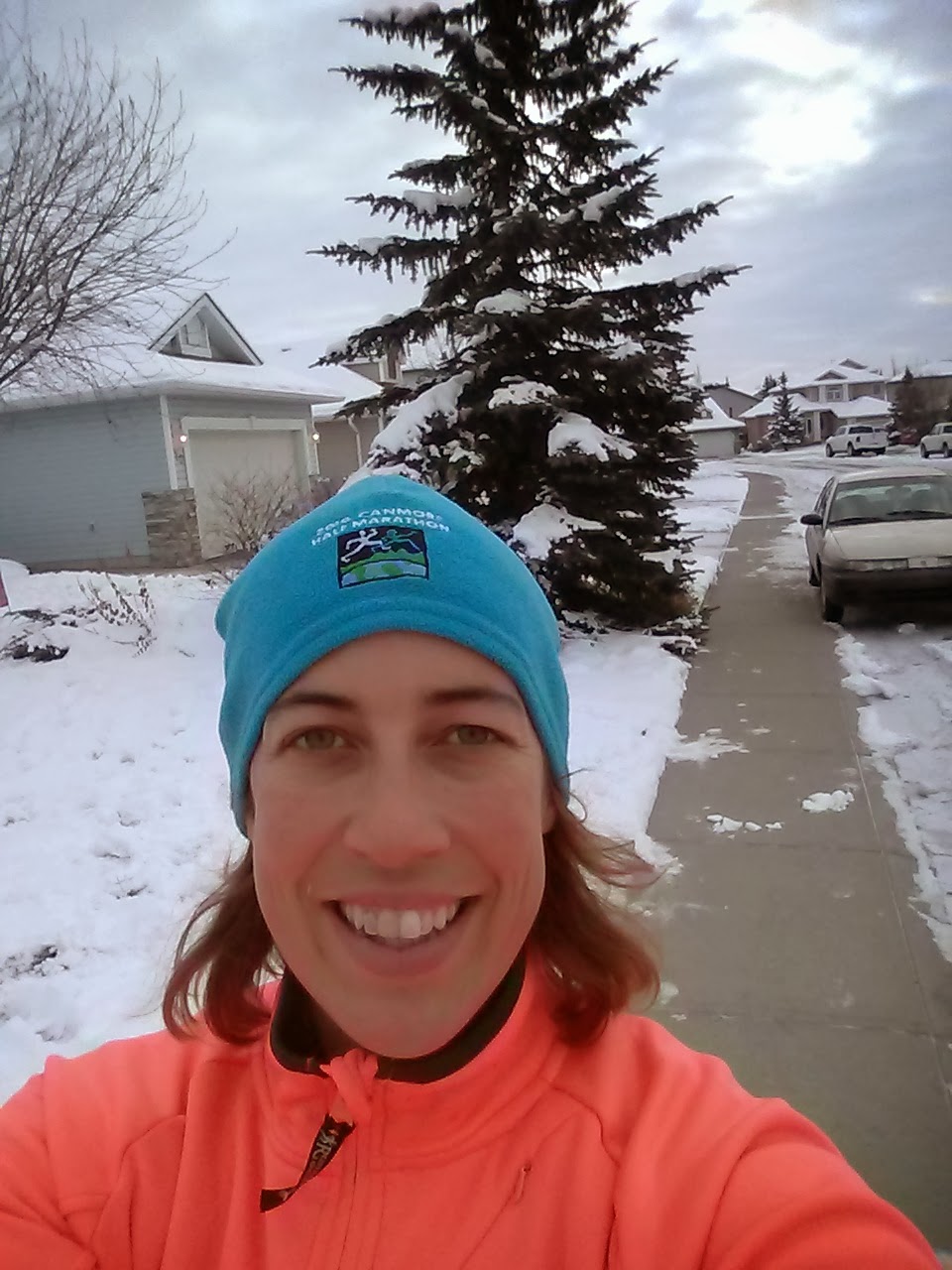
Yesterday's run was just a short one.  30 minutes, with pick ups every 3-4 minutes.  It was around -8c (17f).  The weather website said it was a few degrees colder, with windchill, but there didn't seem to be much wind at all.  It's not really that cold, by our standards, but at the beginning of winter, it seems moreso.  Runner Leana talks about getting our "winter skin" and I like that analogy.  By February, a day like this will be positively balmy.  So, I went out and ran.

There are things you have to keep in mind.  Most important is to watch your footing.  I had to skip the pathways as they hadn't been cleared yet, and appeared to be pure ice.  So, I ran on sidewalks instead.  Fortunately, most people in my neighbourhood are pretty good about clearing sidewalks.

It did mean I would walk a bit when I hit icy sections and I only did my speed pick ups when I was confident I had a nice long clear section ahead of me.  I will add speedwork to the list of reasons to possibly run inside.  It would be challenging to do really structured speedwork when you have to slow down every time you cross a street or go over an icy driveway.

Always beware of patches of snow.  The snow may not be slippery, but it can cover up icy patches.  Part of that is being aware of the recent conditions.  If snow has just fallen on dry pavement, you're probably fine, but if it was wet snow, or it's thawed and refrozen, you need caution.

I haven't had luck with traction aids.  My first year I used yak trax, which were okay, but broke after about a dozen runs.  I also had another one that was kind of like little thumb tacks, but I lost 3-4 of them in my very first run in them, and didn't feel like they helped traction much anyways.  I may look at getting a winter specific pair of running shoes at some point, but I find the best things is just to pay attention.  If you do use traction aids, don't let them fool you into a false sense of security.

When it comes down to it, nothing beats a good outdoor run.  Indoor running is better then nothing, but outdoor running is where it's at.  Even if you have to dress a bit warmer to do it.


Friday, November 1, 2013

The perfect running shoes

Have you found the perfect pair of running shoes?

For quite some time, I wasn't sure they existed.  Every time I bought running shoes, I made sure I could return them, just in case they didn't feel good while running.  They were always okay.  Just okay.  There were a couple of pairs I even considered taking back on my first run, but after a couple more decided to keep them.

My first pair of shoes gave me black toenails.  Like much of the population, I had spent most of my life buying shoes a bit small.  You can get away with small shoes sometimes, but it becomes very obvious when you run in them.  It didn't help that my feet are bigger then women's shoes sometimes are made.  Fortunately, most running shoes do come in size 11 now, so once I identified the problem, the black toenails became rare.

My shoes were always okay.  I figured that was as good as it got.

Until last Christmas, when I bought two new pairs of shoes.  One was a fabulously bright pink pair of Saucony Guide 6's that I wasn't sure I could pull off.  They felt great on my feet though, so I bought them.


And loved them.

These shoes were the perfect shoes.  They fit like a dream.  Good for short runs, or long runs.  Fast or slow.  Really, I just didn't notice them much.  The other pair I had bought at the same time has a narrower toe box, and while I kept them in rotation, in comparison to my fabulous Sauconys, they just didn't measure up.

And the bright pink?  I grew to love it.  It was like saying "I'm a runner!" every time I wore them.  And when I was coming back from my injury, the shoes reminded me of that fact every time I put them on.

Sadly, the time has come to retire them.  I don't keep accurate mileage on my shoes anymore, but I can always tell when they are done.  These ones are sadly done.

I ordered 3 more pairs of guide 6s online, but sadly they ran out of them.  They are giving me Guide 7s for the super price I should have got the 6s for.  I'm a bit nervous about that.  They aren't quite the same shoe, after all.  I can only hope they are the same level of perfection.

So, have you found the perfect shoe?  Do you buy extras when you do?

Tuesday, October 29, 2013

Grabbing hold before a slip becomes a fall

I've been struggling lately.  Now, I'm grabbing hold.

After Calgary 70.3, I took most of August off.  It was the right decision.  I needed a break from the routine and I needed to really want to get back at it.  It worked.

When I went into September, I was excited and ready to go.  Kindergarten year!  Plenty of easily accessed childfree training time!  A 10K in a few weeks, a couple half marathons.  A weekend trip to Arizona in November.  I was prepared to have a great fall season.

And then it didn't quite go how I planned.  The first few weeks were good.  Things were clicking, and I was getting back into it.  How glorious it was to be able to just run again, and not be afraid anymore about whether my foot was actually better.  I no longer felt the need to constantly think about it.  No more niggles from there.

Then I did my first race: The Melissa's 10K, one that I never did get a race report up for.  (It actually is half written, but I never finished it.)

Here's the short story:

Last year, I did this race in just over an hour, so I decided I could do it in just under an hour this year.  Never mind the fact that I spent months either injured or on reduced activity while recovering from that injury...

I pushed myself from the start, and it's a hard course.  You run up a mountain, literally.  At the half way point, I was suffering, but by then you are going downhill, so I figured I could make up time.  At the 7 km mark, I was still pushing.  At the 8km mark, I puked.  Yes, 2 km too soon.  Then I finished it off at a much reduced pace, crossing the finish line about 5 minutes past the hour mark.

The race itself wasn't what did me in though.  Interestingly, I was okay with my finishing time.  I had one of those "look how far I've come" moments.  I reflected on my first 10k, not even 3 years ago, when I finished in a hard fought 1:06.  To be able to finish a much tougher course, on a bad day, in 1:05, really is an accomplishment.

It was training after that did me in.

Because after that race, I started to push myself to run at the pace that I used to be able to run at.  We talk about competition and comparisons all the time.  The only person you should compare yourself to is yourself, right?  And that's what I was doing.  I wasn't trying to keep up with my 20 year old track star self.  I was simply trying to keep up with myself from a year or two ago.

And I couldn't do it.  I'd start out most of my runs too fast, fade badly and finish, frustrated that, once again, I just couldn't hold the pace.  I was falling apart.

Meanwhile a lot has been going on in my family life.  Not bad.  Just changes.  And, quite frankly, I prefer stability.  (This is all a blog post for another time.)

I couldn't figure out how to right myself, how to get back on track.  Finally, I had a good long chat with Angie, my coach.

Getting back on track:

No more pace on my garmin for now.  I am still using it, but the dominant number I'm watching on it is my heart rate.  Pace is recorded, but it isn't displayed.

Getting my food back in line.  I slipped there too.  It's a symptom for me, when things start coming apart, but it can become a disease in and of itself.  Track what I eat.  Base my meals on protein and vegetables.  I still eat plenty of carbs, but the key for me is not to base my food choices around them.  Cut out the sugar.

I've had some good runs.  And a good half marathon.  It was a really challenging course too.  It would have been so easy to blow up on the many hills, but I held an even effort for the race, rather then an even pace.  It let me finish strong.

I haven't felt like I'm quite there yet.  And, tonight, while participating in a spin class with my team, I realized the missing element.  Reaching out to my support structure.  Blogging about my training.  Finding opportunities to train with friends.  I am, and always will be, primarily a solo triathlete.  The time I train alone helps me find my centre, but I also need to run with a friend sometimes or suffer next to each other on trainers.

Deb Tris is back.

Saturday, September 7, 2013

Water running...

So, once I got past my stress fracture, I figured I was done with water running for a while.  Not so.  Just a different kind of water running today...

Today I had 12 km (7.5mi) on the plan.  It was pouring rain.  Whether to do the run wasn't the question, but I did have some options.

Theoretically, I could do it on the treadmill.  That option was discarded pretty quickly.  The treadmill is a great tool when I have no childcare or the paths are actually unsafe (too icy), but neither was the case today.

I could wait until this evening to do it, when it might, maybe, stop raining.  But, I never feel like training in the evening.  I do it anyways regularly, but I much prefer to get it done early in the day.  There's no way I'd want to do it more in the evening.

So, I headed out for a run in the rain.  I actually enjoy running in the rain once I'm going.  There are a few considerations to take into account:

Clothing: The temperature wasn't actually that cold, so I just wore a long sleeved shirt and accepted I'd get wet.  I rarely bother with an actual rain jacket.  Even if they say they are breathable, I find they rarely are.  For me, I usually find that dressing as though it's 5 to 10 degrees cooler works.

Warm up: If you go outside and start running right away, you're probably fine.  I don't.  I generally walk for 5 minutes first (unless running right after a ride).  Skipping this step leaves me feeling creaky when starting my run.   Since realizing I'm not an invincible runner, I am making an effort to follow through on all the practices that keep my body going smoothly.  So, I hopped on my treadmill for a 5 minute walk.  Running in the rain is fun.  Walking in the rain, while dressed to run, not so much.

Shoes: You have to accept that your feet will get wet.  It's smart to avoid the puddles that are ankle deep or ones you can't see the bottom of.  It's unrealistic to try to jump over every puddle or think you can avoid splashing.  Feet will get wet.  Soaking wet.  I've been lucky so far when it comes to blisters, but if you have problems with it, choose your socks wisely.  Don't consider your running shoes to be too precious.  I've done wet muddy runs in retired running shoes and it's always been a mistake.

When I'm done a rainy run, I stuff my shoes with newspaper.  It helps draw out the moisture and dry them out.  I also usually have two, or more, pairs of shoes in rotation.  That's a good habit anyways, but is extra handy if you have to do regular runs in wet weather.

Technology: Obviously you have to be extra careful with any technology you bring on your run.  The only thing I regularly have is my garmin, which is water proof.  I don't usually run with music or my phone.  (I always bike with my phone, but run in town where I am confident I could get help if stuck.)  It goes without saying that you need to have some form of waterproofing for any technology.  A ziploc bag works in a pinch.

Warming up after: I have no problems while actually running, but once I'm done the run, getting out of the wet clothes and into a warm shower is essential.  Otherwise I get a chill that I can't shake off for hours.

I also try to remember how I feel upon finishing a rainy run.  It's usually great.  Rainy runs tend to be fabulous zen type runs for me.  If I can take a mental picture of that mood, it makes it easier to get out next time it's raining.

Monday, August 26, 2013

Sudden speed in the pool

It's been over a year since I broke 2 minutes on 100 metres in the pool.  That was a major achievement for me.  Since then, I hadn't really seen any big jumps in time.  Even the 2 minute mark isn't a given.  I've probably done it less then a dozen times.  I hadn't swam a sub-2 minute 100 since before my injury.  The 1:58 I hit the first time I did it has remained my best time for a year and a half.  Until now...

Friday morning, I was in the pool.  I'm still off coaching for the month, so I didn't have an assigned workout.  I've been feeling the need for more structure though, so I was following the general formula that Angie uses in my swim workouts.  A warm up, some drills, some steady swimming, then I decided to throw in a bit of speed work.  Not much: 4 x 25m, 2 x 50m, 1 x 100m.  (25m is one length of the pool, so 50 is there and back, while 100 is there and back twice.)

The 25m were feeling good.  I wasn't breaking any of my records on them, swimming them in 27 or so seconds.  It was solid though and I held the pace for all 4 of them.

Then on to the 50s.  What the heck?  55 seconds?  Maybe I timed myself wrong.  Maybe the pace clock was off?  (I'd forgotten my garmin, so was going entirely off the pace clock.)  Then I did it again.

I rested on the end of the pool contemplating it.  This could very well be the morning when I could get under 2:00 again, I thought.  I gave myself a full 90 seconds rest.  This was important to me.  My swimming felt clunky for a long time during/after the injury, and even though I'd had some good races, this sub-2 minute hundred is like the sub-30 minute 5K for me.  It's one of those steps that was a barrier for a long time.  When it's been a while since I've achieved it, I want to prove to myself that I am still capable.

I watched the pace clock make it's way around.  I was starting on the red top.  Then it was go time.

The first 25 metres I concentrated on swimming steady.  I almost always go out too fast and can't hold it.  No lolly gagging or sand bagging, but if it felt hard this soon, I knew I'd be in trouble.

Onto the next 25.  Swimming strong.  Uncomfortable.  I could just stop at 50.  Nobody would know.  No.  I would know.

The third 75.  I had no idea how I was doing timewise.  You lose time when you stick your head up to look at the pace clock, after all.  It was hard.  From looking at my garmin stats, this is the part I always slow down.  Stay strong...

The last 25.  It hurt.  But, it was also in the final stretch.  You can do anything for 30 seconds.  Anything.  I tunnel visioned my focus onto my technique and ignored the pain.  Body roll, high elbow.  Push down that little bit with my chest to keep my hips up.  Don't lift my head...

I hit the wall.

1:54

1 minute, 54 seconds.

FOUR seconds faster then I have ever swam 100 metres.

When I first started swimming, a 4 second improvement was easy to come by.  Now, not so much.  Very pleased.

Friday, August 23, 2013

Racing for fun - Strathmore race report


What do you consider to be a fun race?  I used to have it in my head that it would be the kind of race that I would just toodle along.  Something I didn't care too much about.  Maybe do it with friends.  No stressing the training going in and no stressing race day.

I had a couple of races where I tried to do just that and they were utter failures.  Either, I didn't find it fun, or I abandoned the plan partway through.  Finally I realized that a "fun" race for me is one that I push hard enough that I finish feeling like I'm going to puke.  Where I leave everything out on the course, and there's no "could I have gone faster?"

I raced last weekend!  It was a spur of the moment decision.

I'd decided to take August off of racing, and go easy on training.  Easy was supposed to mean, still doing it, but not stressing about following a schedule.  In reality, what happened is getting time to train got a lot harder.  My kids aren't in daycamps anymore, and my husband has been working overtime almost every night, often not getting home until 10:00pm.  Without a race on the schedule, or a plan, I just didn't feel like going to the extra effort to make the training work.  It is rather painful to put one's bike on the trainer or run on the treadmill in August.  So, I've had only a handful of swims and runs in the three weeks since Calgary 70.3.

Last week, Runner Leana mentioned on her blog that she was doing Strathmore, a local women's only race that I did two years ago.  I was hit with a serious case of race envy.   When I checked the race website, there were still spots.  This race always fills up, so that seemed like a sign.  I debated it briefly, then signed up.  Then I tri-pushed and got Kim, another friend, to sign up.   It was going to be an awesome day!

Race day dawned bright and early.  I car pooled with Kim to the race, and we had a relaxing drive chatting along the way.

When we got to the race, it was social centre.  There were lots of Team Trilife people there and I kept running into somebody I knew.  We cheered for people coming out of the swim and hung out.  Before long, it was time to race.

The Swim

Since this is a pool swim, it's a staggered start based on your estimated swim time.  I'd estimated my swim time as 12-13 minutes, then second guessed it.  I swam just under 12 in Vulcan when I still had the stress fracture and wasn't pushing off properly.  I hung back a little bit, so that I'd be near the end of my wave.  You always start with slower people and finish with faster people so best not to stress too much about it.

Photo Courtesy of Neil, Runner Leana's husband
I jumped in and started swimming.  It had been a while since I'd last swam, so I was taking the first 50 metres to settle into my pace.  Not too hard.  I know that if it doesn't feel easy for those first 50 metres, I'm probably going way too fast.

When approaching the wall at 75 metres, my foot got tapped.  I stayed on my side, and let the woman behind pass me.  Then I pushed off right behind her to see if I could catch her draft.  Yep.  She was going at a decent pace, but I had no trouble holding on to her.  In fact, after a few more lengths, I started wondering if she was fading.  It was feeling easy, but I wasn't sure if that was just because I was drafting.  Was it worth the effort to pass?

I decided to keep hanging out behind her.  I figured even if I swam slightly slower, I would at least go into bike fresh.  I find a lot of people can decide to speed up if they think they are being passed, and I didn't feel like going to battle.  With 100m left, I accidentally tapped her toe on the push off, so at the following wall, she let me by.  I had a great rhythm for those last 75m, and realized that I probably should have passed.  I could feel how much faster I was.  My garmin confirms that I swam much slower between 200m and 425m then I did for the rest of it.

Then I was up and out of the water.  You have to walk on the pool deck, so I used it as a moment to catch my breath before heading out the door and running the rest of the way to transition.  Yipee!

Swim: 12:46 for 500m (includes time walking to lane and out of pool.)

Bike

The bike I felt really strong.  I debated whether I should hold back to save energy for the run, but decided I would just push it and keep pushing it.  I was willing to take the risk of blowing up because with such a short distance, I figured I could pull off a finish even if it really hurt.

The fun thing about a staggered start is that you get to pass lots of people on the bike.  I made it a goal to catch up and pass every person that appeared ahead of me.  I figured it wouldn't take long for faster people to start catching up to me and passing me, but it didn't happen once.  Not once!  I wasn't passed at all.

I underestimate myself on the bike.  What I thought was a hard, maybe risky effort was probably a completely appropriate race pace for a sprint.  Truthfully, with more consistent training leading up to it, it could even be an appropriate race pace for an olympic.

Then, pulling back into transition.  I got off my bike and headed for my spot.

Bike: 44:47 for 20km (Time includes both transitions.)

The Run

The run.  This one has been my wild card this season.  Leading up to Calgary 70.3, I'd only been doing run/walk intervals.  Once I completed Calgary 70.3, I finally had the confidence that my foot was truly healed.  So, I was going to run it.  The whole thing.  I even had the hope that maybe I could pull of a sub-30 minute run, something that I hadn't accomplished since early this year.

I seem to have a pace that I almost always fall into off the bike, about 5:30/km.  In any longer race, this is the time to look at my pace, and pull back, because I can't possibly sustain that pace over the long haul.  This time, I didn't look at my pace, and I didn't hold back, because I was going to run this thing, damn it.

Within the first kilometer, it was feeling hard.  I'd gotten so used to the run/walk intervals, and I was taking that away from myself.  No walking!  This is what I've been waiting for, I reminded myself.

I started to get into my rhythm.  It was still hard, but it was maintainable.  I could hold it.  Every time I got the urge to walk, I reminded myself that I would have killed to be able to run this race three months ago.

I grabbed some water at the aid station and kept running.  Except it was in hard plastic cups!  Boo.  You can't pinch those to drink while running.  So, I just aimed for my mouth, got a bit in and most of it on my shirt.  No worries.  It was hot anyways.

I was hurting, but feeling so good on the way back.  I barely looked at my garmin.  It didn't matter.  What mattered was that I running.  I smiled.

With one kilometer to go, I picked up the pace.  I felt so strong.  The finish line was in sight.  I shut off the part of my brain that tells me I hurt and just concentrated on moving my body.  Running tall, running strong.

And I crossed the finish line.

Run: 28:59 for 5K.

This may be the closest I've ever come to puking upon crossing finish line.  I was actually looking around for a garbage can in case I couldn't stop myself, but before long, I had my breathing under control and was feeling good again.

This race was a victory for me.  I thought Calgary 70.3 was my come back race, and it was.  But, in a way, so was this.  This race, I was able to do without holding back.  Without fearing the injury and without feeling like I had to play it safe.  I raced with everything I had on that day.  I proved to myself that I still have it.  If anything, getting through this injury has made my mental side so much stronger.  Nothing can stop me now.

Total time: 1:26:30 (A minute and a half faster then last time I did this race.)

Tuesday, August 13, 2013

After the big race - reflections on getting through the injury

It's been over 2 weeks since finishing my second half ironman.  The journey to get there was a lot more difficult then for the first one.  Interestingly enough, the actual race was easier.  As happy as I am overall with it, I feel a little disappointed in that aspect.  On one hand, I feel like I didn't put everything I had on the table.  On the other hand, I recognize that I raced very safely.  Not every race should be a "safe" race, but I was at a point where that's what I needed to do.

Coming through my first injury has been a huge learning experience.  Now that I'm on the other side of it, I can look back at that process with interest.

For a very long time, I wallowed.  I've received plenty of comments commending me on how well I took it, or how positive I was dealing with it.  Let's just say that the public face I put on is often different then what's really happening.  Actually, that's not entirely accurate.  A more accurate statement would be to say that I avoid public (including my blog) when I don't like the face I'm wearing.  What I say on my blog, I believe to be true (though sometimes I am in denial of reality), but when I don't blog, that's when I'm not so positive.

I think the first injury is really tough for any athlete.  It sure was for me.  Running is the one discipline that I never stopped, even at times when I took a bit of time off of swimming or biking.  Running used to be a great big "I can't".  I was afraid that if I ever stopped, I might never start again.  And I love running.  Really truly love it.  There is nothing else that gives me the rush that I get from running.  I felt like I had a part of myself ripped away when I found out I couldn't run.

Knowing that I can work through an injury has given me strength going forward.  When I first found out I had the stress fracture, I was sure I would never be glad it had happened.  While "glad" isn't quite the right term, I think it's become a valuable experience.

For one thing, injuries are a reality of doing sports.  I had a fear that an injury could be a show stopper for me, an end to triathlon.  I no longer believe that.  If I get injured again, it will be with a knowledge that I possess the strength to get through it.  Any injury sucks.  It almost always means short term plans are compromised, but I now know that in the long run, it makes me stronger.

There are things we can all do to lessen our risk of injury.  I wasn't doing most of them.  Despite the presence of strength workouts in my training plan, I rarely did them.  I did core work when I attended spin class, and not consistently on my own.  I continued to carry unnecessary extra weight on my frame, and while it probably wasn't a factor in this injury (statistically a low weight puts you at higher risk of stress fractures), it increases my chances of other injuries.

While injured, and recovering from injury, I did physiotherapy.  Initially, it was to address the muscle loss I incurred from wearing the aircast.  Then we started addressing muscle imbalances and general strengthening.  She added a couple exercises a week, and before I knew it, I found myself doing a full body strengthening routine, including core.

When I started this season, I thought I'd accomplish huge things physically.  I knew I had untapped potential, and I intended this to be the season that I tapped into it.  I planned to hit new speeds and blow away my old personal bests.

What I hadn't anticipated was this was the season I was meant to become stronger mentally.  This was the season I needed, to find strength within myself.  To learn that I have the ability to get through the hard times, rather then just riding through the good.

Training the mind is the biggest part of getting stronger.  That little bone in my foot has taught me some valuable lessons.